Tuesday, December 17, 2013

My "To Do" schedule!

I know, I know, I've really been slacking on my blog game lately. I'm sorry to those of you who are kind enough to keep reading my blog. I haven't abandoned you! But, I'm sure many of you know how hectic things can be in an elementary school in the weeks leading up to the winter break. It's been crazy! Fun, but certainly busy. Which actually leads me very nicely into the topic for today's blog post: SCHEDULING. My schedule, from day to day, is fluid to say the least. As the say, "the best laid plans often go astray". Each morning I look at my list of meetings, lessons, groups, and check-ins, and put a schedule together of when each of those things will happen. However, in this role, there are several things that come up throughout the course of the day, like students in conflict, and student in crisis, phone calls from parents, etc., that can throw that schedule into pandemonium.

When I first started out the school year, I had a desk calendar where I would write my schedule down for the week. However, as things came up and other things got rescheduled, the calendar started to look like one giant cross out and scribble. It was unmanageable, and I realized, unrealistic to keep a schedule like that.

My wonderful friend, Amanda Sheroff, at School Counseling A-Z, inspired my new scheduling process. Something she has started doing is keeping her schedule on a piece of laminated paper with a dry erase marker, so it can can easily be changed, added to, and edited throughout the school day. I've adopted this form of scheduling, and it has been wonderful. I have five laminated sheets of paper, one each day of the school week, that is broken down into categories like "meetings", "groups", "check-ins", and then I have a space at the top where I put the lessons that I am teaching that day. I display it on the filing cabinet next to my desk, so I can quickly refer to my schedule throughout the day and add and change things as they come up.

Here are examples of what my schedules look like:


Wednesday, November 27, 2013

1000 VIEWS :-) THANK YOU!

THANK YOU FOR READING! It makes me so happy to know that some of my thoughts and ideas are reaching you. I know that reading counseling blogs is one of the best resources I have found, and I hope this blog continues to turn into a place where other counselors can come for inspiration or ideas! THANK YOU AGAIN! :-)

Monday, November 25, 2013

"Rocking" Good Character

Character education is a huge part, in my opinion, of what makes schools successful. It can be difficult for children to function effectively in school when behaviors, either their own behaviors or the behaviors of their peers, are less than stellar. However, getting students to buy in to character education can be a struggle. It is important to make the character education plan fun, relatable, and rewarding for students.

At my school, a few years back, an awesome committee of teachers and staff developed six "keystones" of good character to be highlighted throughout the course of the school year. Each keystone has it's own definition and expectations, and through different activities each keystone is introduced throughout the course of the school year. The keystones are: responsibility, conservation, respect, citizenship, trustworthiness, and appreciation.

This year, our keystones are being celebrated with a "you rock" theme, which was inspired by Entirely Elementary School Counseling's "You rock kindness" bulletin board. I used several of the same ideas, but modified it to include each keystone of good character.


At the end of October, we had a school wide "Keystone Kick Off Assembly". The assembly included 12 students from out 5th grade class that helped present each of the keystones. Six of the students read the definition of each keystone. Next, we had six students who each had an actual rock with a keystone written on it come up to the stage. On the stage, we had a camera focused on a bowl of water. Each student took their rock, placed it in the bowl of water, and discussed the "ripple effect" that occurs when students are responsible, respectful, trustworthy, appreciative, or when they are good citizens, as well as when they conserve. The students talked about the effects their good behavior and character can have on the entire school population.


To go along with our "YOU ROCK" theme, we have tickets to be handed out to students when they are "rocking" the keystone that is the focus of that month. For example, this month, the keystone is "responsibility". When students do something responsible, they get a "you rock" ticket, which is put in an envelope. At the end of each week, one student from each class has their name randomly chosen from the envelope, read over the announcements, and then they come to the office to receive a pencil and get their picture taken for the "YOU ROCK" bulletin board.


The response to the program has been outstanding so far. The students are very into the "YOU ROCK" tickets and the staff has been very supportive, making sure that they hand out tickets to reward good behavior. Hopefully, things continue on this path for the rest of the keystones! :-)

Friday, November 8, 2013

Run for Autism

Since college, I have had the awesome opportunity to work with school aged children diagnosed with autism spectrum disorders. I say awesome because that is truly how I feel about each of these experiences. I did my student teaching in a full inclusion first grade classroom where I had students who were on the spectrum. Many of my favorite moments from those 4 months were when I felt that I had really made an impact and a connection with those students. I left feeling that I learned more from them than they learned from me. After college, while I was in graduate school, I worked in an autistic support classroom. That experience, while certainly a challenge in many ways, was one of the best experiences of my life. Now, as a school counselor, I am lucky to have the opportunity to work with many children on the autism spectrum every day in social skills groups, de-escalation strategies, and sensory strategies.

Children (and adults) diagnosed with autism are inspiring in so many ways. It is hard to imagine some of things that these children go through on a day to day basis, and they consistently persevere. I have learned so much from working with children with autism about strength, courage, and never giving up, no matter how difficult something may be to get through. Because of these experiences and the strength of those with autism spectrum disorders, I have decided to partner with the "Organization for Autism Research" to Run for Autism. Next Sunday, November 17th, I will be running the Philadelphia Half Marathon (13.1 miles), for OAR. I have set my fundraising goal at $600, and I have until December 17th (one month post race) to raise the funds. I decided to share this story with my readers in hopes that some of you may be able to support this fantastic cause. With your help, we can raise the money so many children and adults need to fund research studies in order to find highly effective treatments, tools, and strategies to improve the lives of people with autism. I have provided the link to my personal fundraising page here:

http://my.e2rm.com/personalPage.aspx?registrationID=2169206&langPref=en-CA

Thank you all so much!

Wednesday, November 6, 2013

Becoming a "Feelings Detective"

One of my favorite parts about my job is the opportunities I have to get into classrooms and teach lessons on various topics such as emotional health, feelings, how to be a good friend, bullying, safety, and a million other different topics. Currently, I am spending the week with my first graders, and we are talking about feelings.

Most first grade students know what feelings are. If you ask them what feelings are, they can rattle off happy, sad, and mad pretty quickly. Obviously, there are lots of other feelings for children to learn about a long the way, as well as how to recognize when someone is feeling a certain way. In order to accomplish that, both the group of students that I am working with and myself turn into "FEELINGS DETECTIVES"!

As soon as the kids hear that we are going to be detectives, they are already excited. First, we talk about what detectives do (they solve mysteries) and what they need to look for to help them (they need to look for clues). Then we talk about what a "feelings detective" does (a feelings detective uses clues, like someone's face, to figure out how they are feeling). After we talk about all of those things, I invite a student up in front of the group to role play what a feelings detective might do. I pretend to be sad and crying. The student typically always says "what's wrong?". I tell them that no one will play with me at recess. Every time I have done this activity, the student says "I will play with you!". Then the whole class talks about what clues the student used to figure out how I was feeling (my face, I was crying, etc.), and why it was important (so that he/she could make me feel better).

Next, I tell the students that I brought along pictures of some of my friends, and that we are going to use our imaginary magnifying glasses to look for clues in the pictures about how my friends might be feeling. We look at a series of pictures covering the feelings happy, sad, angry, afraid, surprised, and disgusted. Each time I show the students a new picture, they put up their imaginary magnifying glasses to look for clues. For each picture we discuss several clues that tell us how the person in the picture is feeling. For example, in the picture of the happy child, students point out that she is smiling, her cheeks are puffed up, her eyes are scrunched in the corners, etc. For angry, students point out that the child's arms are crossed, she is glaring, she is frowning, etc.

After we discuss each picture, depending on time, I would read them a story about all the different feelings, such as "The Way I Feel" by Janan Cain (get it here: http://www.amazon.com/The-Way-Feel-Janan-Cain/dp/1884734715/ref=sr_1_1?ie=UTF8&qid=1383765495&sr=8-1&keywords=%22the+way+I+feel%22), and talk about all of the different feelings covered in the story.

At the end of the lesson, tell the students that they have officially graduated to be being "feelings detectives"! And what graduation is complete without a certificate? I created a template for a "feelings detective" diploma and wrote each child's name on it. I call each student up individually and shake their hand and give them their certificate. This obviously takes some time, but it's worth it, because the kids are over the moon to be getting something that they can take home.

Here is a photo of all of the materials for the lesson:
 
 
I had lent my copy of "The Way I Feel" to someone in the building, so for this particular lesson I used the book "Beginning to Learn About Feelings" by Dr. Richard Allington and Katheen Cowles. (Currently unavailable on amazon.com).
The photos that I use are from out developmental curriculum called "Second Step", and they have several discussion questions and prompts, as well as explanations on the back of the cards. There is also a picture of the certificate, and an up close photo here:
 

Thursday, October 24, 2013

We Are Proud To Be Drug Free...Celebrating Red Ribbon Week

Every year toward the end of October, schools across the country have the opportunity to participate in the national "Red Ribbon Week" campaign, which is a week where students learn all about living a drug free and healthy lifestyle. "Red Ribbon Week" carries such an awesome message, however, it can sometimes be difficult at the elementary level to approach the topic of drugs and alcohol, especially if students do not yet have background knowledge. In order to start spreading this message in a kid friendly way, my principal and I worked together to come up with some fun ideas to get the students at my school involved in "Red Ribbon Week". This year, as in other years, each day of "Red Ribbon Week" had a drug free theme attached to it. For example:

Monday- "Orange you glad to be drug free?!" Everyone is encouraged to wear orange clothing to school.
Tuesday- "Sock it to drugs!" Everyone wears their craziest socks to school.
Wednesday- "Put a cap on drugs!" Everyone wears hats throughout the school day.
Thursday- "I'm a 'jean-ius', I'm drug free!" Everyone wears jeans to school.
Friday- "Team Up Against Drugs!" Everyone wears their favorite team jersey or t-shirt to school.

The kids and the staff were all encouraged to participate in each theme day, and the kids were really enthusiastic about it. Overall, it was a great way to spread the "drug free" message in a way that really got kids involved, as opposed to just talking about it.

As part of "Red Ribbon Week", I also ordered little gifts for each student in the school. On Tuesday, we handed out actual red ribbons (with an adhesive back), for students and staff to wear throughout the week. The message on the ribbon was "Celebrate Red Ribbon Week, Not Just a Week but For Life". On Wednesday, students each received a pencil with the same message printed on it. On Thursday, paper bracelets were handed out with "My future is bright, no drugs in sight!" printed on them. All of these awesome products were purchased from www.positiveredribbonweek.com.

I am lucky to have an awesome student council at my school. They were incredibly helpful in supporting "Red Ribbon Week" this year. Students involved in student council were asked to make posters with a positive "drug free" message on it. They were hung up all around the school as a way to keep spreading the message. The students really put a lot of extra time and effort into these posters, and seeing them hanging up all over the school has been really awesome.


Lastly, students signed a banner, which served as a school wide pledge. "NPE Is Proud To Be Drug Free!" Each class was asked to take some time throughout the week to come down and sign the poster as their promise to live a drug free life.

Overall, the week has been very successful. Hopefully, all students, starting in Kindergarten and reaching all the way through 5th grade (the highest grade level in my building), have gained a better awareness about living a drug free life, and hopefully they had fun getting there! :-)

Tuesday, October 8, 2013

Introducing the School Counselor

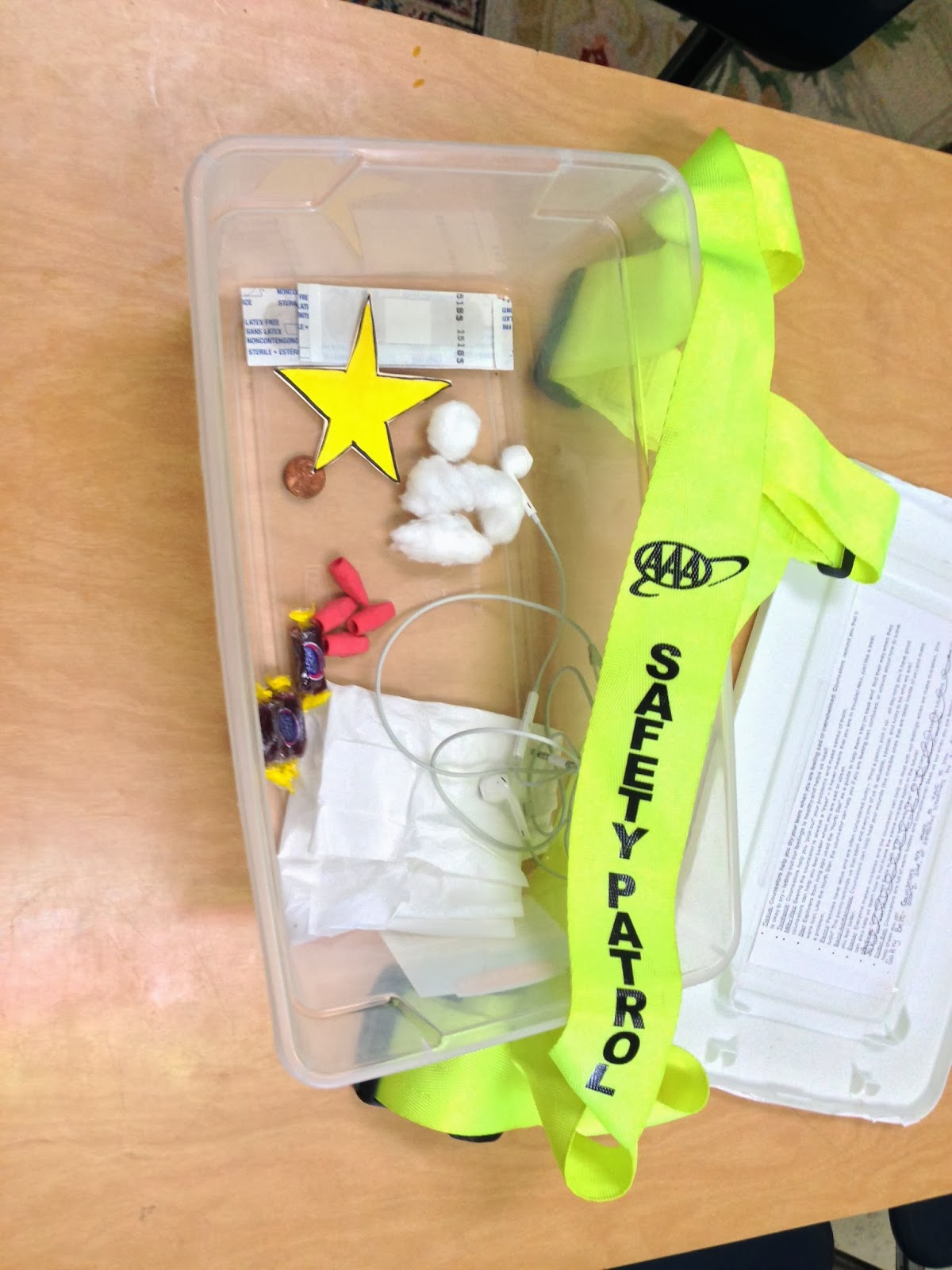
As I mentioned in an earlier post, there are many people who do not really know what the role of the school counselor is at the elementary school level. In many school districts, the school counselor position is relatively new. If it is difficult for adults to understand what the school counselor does, how can children possibly understand? It is something that I struggled with. I wasn't sure how to effectively explain the many different things the school counselor does on a day to day basis. As I was searching "pintrest" for ideas on how to introduce the role of the counselor, I found an awesome intro lesson pinned by savvyschoolcounselor.com. The counselor's first aid kit!

I adapted the first aid kit a little bit from what was in the kit featured on savvyschoolcounselor.com. In my tool kit, I included:

  • Tissues-When you are feeling sad or upset, the counselor is a great person to talk to. The counselor can help you dry your tears, but also remind you that crying is OK, and even healthy!
  • Jolly Ranchers-Going to see the counselor never means that you are in trouble, it is always a treat! Even when you're upset, the counselor can make you feel better, just like a treat can.
  • Star-Like the North Star can guide people when they are lost, the counselor can act like the "North Star" of the school by helping if you are feeling lost, you are confused, or you are unsure how to solve a problem.
  • Penny- "Find a penny, pick it up, all day long you'll have good luck!" The penny represents how the counselor reminds each and every student that we are lucky to be who we are and that we are valuable.
  • Band-Aid- Counselors help to heal you when you are hurt on the inside, just like a Band-Aid helps us heal when we are hurt on the outside.
  • Erasers- Everyone makes mistakes. The counselor can help you to work through your feelings when you make mistakes, can help you fix mistakes, and teach you not to make the same mistakes again.
  • Cotton Balls- Just like a cotton ball feels warm and fuzzy, the counselor has warm and fuzzy feelings, too! Whenever you are feeling down, the school counselor can help you feel better.
  • Safety Belt: The counselor is always there to help you feel safe, and to save you from scary, upsetting, or stressful situations. The counselor can provide support, help, and love to get you through the tough stuff.
  • Headphones- The counselor is a great listener, and is always there to lend an ear when you need to talk to someone.
When using the first aid kit in an introduction lesson, I pull each item out one at a time, and I have the students pass them around. I ask what each item is usually used for. Then, I ask for ideas about why I might have that item in my "counselor's first aid kit", and use that discussion to explain the many roles, and how activities like groups, lessons, and lunch bunches fit in. For example, classroom lessons fit in the explanation of the star. I teach students how to solve problems, how to be a good friend, how to make good choices, etc. Lunch parties and groups can fit in that description, as well as the jolly rancher/treat explanation as well, in that groups are fun, and we work on many different skills to get us through tough situations.

If there is time after talking about each of the items, I read a story, usually about a character that is having a problem with a friend or a certain feeling. Good examples would be "Angry Arthur" by Hiawyn Oram, "Stop Picking on Me" by Pat Thomas, or "Alexander and the Terrible, Horrible, No Good, Very Bad Day" by Judith Viorist. Once I finish the story, as a group we discuss how the characters in the story may have been able to get help from the school counselor. It is a great way to connect the things we talked about to an actual situation!


My home away from home :-)

My home away from home :-)
My office!